

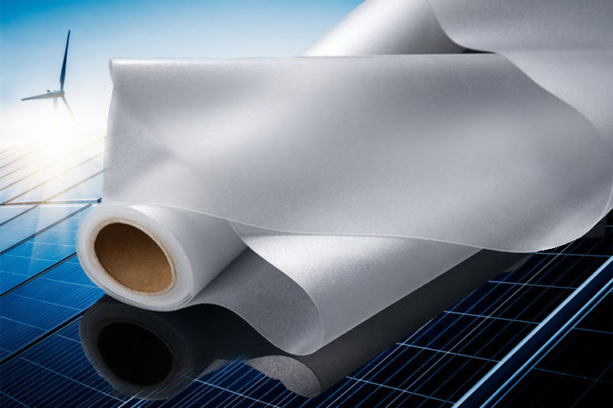
In today’s global energy transition and fight against climate change, solar panels have become one of the key solutions for sustainable development. However, the efficiency of solar systems depends not only on the photovoltaic modules but also on auxiliary materials. One of the most critical is EVA film (ethylene vinyl acetate), which plays a crucial role in encapsulating solar cells by providing protection, durability, and stable performance.
How are solar panels manufactured?
- Production of silicon wafers: purified polycrystalline or monocrystalline silicon is used to create thin wafers 160–200 μm thick.
- Application of semiconductor layers: layers that form a p-n junction are applied to convert sunlight into electricity.
- Contact installation: metal conductors (front and rear contacts) are applied to collect current.
- Encapsulation: solar cells are placed between EVA film layers and glass (front) and a backsheet (typically Tedlar or glass).
- Lamination: under heat (about 150 °C) and pressure, the EVA film melts and firmly bonds all layers.
- Installation of junction boxes and frames, followed by testing of the final modules.
What materials are used in solar panel production?
- Silicon (Si) — the primary semiconductor for solar cells;
- EVA film — for encapsulation and protection;
- Glass — external protection and light transmission;
- Backsheet — typically Tedlar (PVF), PET, or glass;
- Aluminum frame — for structural integrity;
- Conductive elements — copper, silver.
Why is EVA film better than alternatives?
| Property / Material | EVA Film | POE Film | TPU Film |
|---|---|---|---|
| UV Resistance | High | Very High | Medium |
| Transparency | > 95% | ≈ 92–94% | ≈ 90% |
| Cost | Medium | Higher than EVA | High |
| Waterproofing | Excellent | Superior | Good |
| Element Compatibility | Excellent | Good | Medium |
| Service Life | 25–30 years | Up to 30 years | 20–25 years |
| Lamination Ease | High | Requires fine-tuning | Medium |
| Market Availability | Very High | Medium | Low |
| Technological Maturity | Time-tested | Relatively new | Limited |
| Performance Stability | Reliable | Needs monitoring | Variable |
Why use EVA film in solar panel manufacturing?
- Optimal price/performance ratio;
- Proven long-term durability in the industry;
- Compatibility with equipment and manufacturing processes;
- High transparency and strength to securely hold components in place;
- Mass production availability.
Technical characteristics of EVA film
| Parameter | Value |
| Thickness | 0.3–0.8 mm |
| Light transmission | ≥95% |
| UV Resistance | High |
| Adhesion to glass | ≥1.2 N/mm |
| Thermoforming temperature | 140–150 °C |
| Processing time | 10–15 minutes |
| Service life | 25+ years |
Real-world application examples
Example 1: Solar farm in Spain
At a solar plant in Murcia, 80,000 panels were installed using EVA film. After 10 years, power loss was only 6.5%, compared to up to 15% without proper encapsulation.
Example 2: Private home in France
A family in Lyon installed solar panels with EVA encapsulation in 2020. After 3 years:
- annual energy generation averaged 5,200 kWh;
- annual savings — around €980;
- panel degradation — under 1.5%.
Advantages of EVA film
- Reliability: protects against moisture and corrosion;
- UV resistance: special additives prevent degradation under sunlight;
- Stable performance: low power loss over time;
- Economic efficiency: reduces maintenance and extends panel lifespan.
Outlook and innovations
Enhanced EVA films with improved transparency and yellowing resistance are being actively developed. POE films are gaining popularity, but EVA remains the top choice thanks to its balanced performance and accessibility.
Conclusion
EVA film is not just an accessory but a vital part of solar module construction. Its quality affects overall panel efficiency, longevity, and return on investment in solar energy systems.
Want to learn more or order EVA film?
Contact us in a convenient way or submit a request on our page. We’ll help you choose the best solution for your project.